The life of the equally apostolic saint Mary Magdalene
In the Orthodox Christian Church, "equal apostles" are called the co-workers of the Apostles of Christ and also those righteous Christians who, like the Apostles, especially zealously preached and affirmed the Christian faith.
They were especially honored because of the privilege they received from the apostles. The word "apostle" means one who is sent to do a certain work.
After choosing twelve of His disciples, Jesus Christ called them "apostles" (Luke 6:13) to send them out to preach (Mark 3:14) and to heal every disease and infirmity (Matthew 10:1-42).]
For example, in the letters of the apostle Paul.
And when referring to a righteous person, the early Christians avoided using the term "saint" because it was often used in pagan inscriptions, which Christians did not want to imitate.
And in the ancient calendars, the word "holy" for the name of a saint venerated by the Church was used only from the third and following centuries, and in the Gospels, holiness is represented as a Christian attribute in all its manifestations: "Hallowed be Thy name"... "Holy Father"...
"Sanctify them in your truth . . . peace-bearer [Peacemaker Mary Magdalene is named after the Evangelists name her the first of the pious women who came to Christ's tomb to anoint His body with fragrant compounds according to the pious custom of the Jews of that time.
These compositions were made from resinous substances of myrrh, myrrh, frankincense, aloes, and other fragrant plants mixed with pure olive oil.
By anointing or sprinkling the body of the deceased with such fragrant compounds, they expressed love and honor for the face of the deceased.] Mary Magdalene [name Mary from the Hebrew Maryam means "high, exalted, enduring, excellent, exalted"; and this Mary is called Magdalene from her native town
The Magdalenians, like the pious Sanhedrin member Joseph, are called Arimatheans because they were from the Palestinian city of Arimathea.
And the surname Magdalene is added to the name of this Mary to distinguish her from other pious women, as well as she, who served Jesus Christ (Luke 8:3) and who had the same name Mary, as, for example, Mary, the sister of Lazarus, and Mary, the wife of Cleopas.] , especially famous in the Christian Church for her zeal,
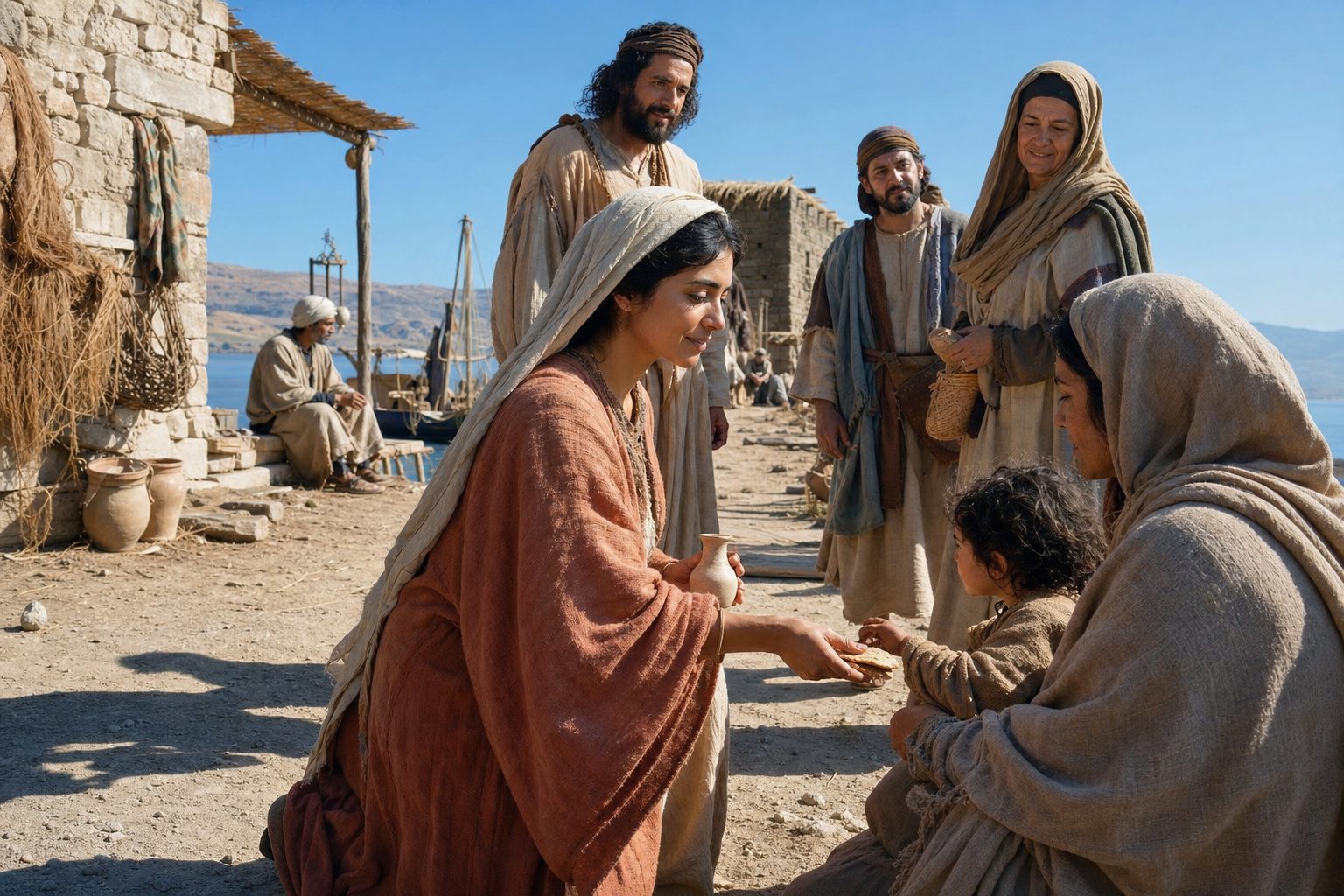
She was a native of Magdala, a city on the western shore of the Lake of Gennesaret, near Capernaum and Tiberias.
Magdala was famous for its dyeing and fine wool products; besides, there was extensive trade in hornets and pigeons for purification sacrifices; the legend attributes to Magdala three hundred pigeon shops and a whole valley of "pigeons" nearby.
Magdala's wealth was so great at the time that the tax collected from the city was so great that a whole wagon was sent to Jerusalem.
Of the many towns and villages that dotted the shores of Lake Gennesaret, all have disappeared except one, Magdala, which is now called Medjdel and is a group of mud huts made of coastal stones, with flat roofs with upper floors made of reeds and reeds.
It's a tree.
But the remnants of the ancient watchtower still exist and the location is still beautiful: the beauty of nature is also solemn and awakens the holy delight of the miracles and preaching of Christ at the amazing lake of Gennesaret or Galilee.]
Palestine, or Galilee (from the Hebrew word "Galilee", meaning "region", "neighborhood") in the time of Mary Magdalene constituted the third region of Palestine, and Galilee itself was divided into the northern, upper, "pagan", and the southern, lower, Galilee occupies a prominent place in world history as the homeland and
The place where Christ the Saviour preached.
It was bounded on the north by Syria and Lebanon, on the west by Phoenicia, on the south by Samaria, and on the east by the Jordan.
There were over 200 cities and large settlements in Galilee, with a population of up to four million, made up not only of Jews but also of a mixture of Syrians, Phoenicians, Arabs, and other Gentiles, many of whom had converted to Judaism.
And the Galilee was the best region in Palestine for its wonderful climate, for its fertility, for its wealth, for its mild, for its pleasant climate, for its diversity of natural beauty, for its inexhaustible fertility of the soil, for it was all in Galilee.
Its geographical location and the abundance of trade routes also favored Galilee, which was crossed by several Roman trade routes from east to west to Damascus, to the Phoenician coasts, to the Mediterranean, to Egypt, and to Assyria; other routes cut it from south to north.
Many pages of the Gospel reflect the nature and life of Galilee, the birthplace of Christ the Saviour, the city of Nazareth, where he spent his childhood, youth and preaching, Galilee was the cradle of the Christian faith.
And the parables, the miracles, the events of the daily life of Jesus Christ on earth, all these images, all these images, all these images, all these images, all these images, all these images, all these images, all these images, all these images, all these images, all these images, all these images, all these images, all these images, all these images, all these images, all these images, all these images, all these images, all these images, all these images, all these images, all these images, all these images, all these images, all these images, all these images, all these images, all these images, all these images, all these images, all these images, all these images, all these images, all these images, all these images, all these images, all these images, all these images, all these images, all these images, all these images, all these images, all these images, all these images, all these images, all these images, all these images.
Heaven, earth, sea, fields of corn, gardens, flowers, vineyards, meadows of grass, fish and birds, all served there as the Savior's foundation and form of the marvelous teachings of His divine preaching...
And in our time Galilee is just ruins of cities and villages and complete desolation...] region of Palestine, on the shore of the lake of Gennesaret, or otherwise the Sea of Galilee [Lake of Galilee, Lake of Gennesaret and Sea of Tiberias are the name of the same vast lake in Galilee
The Palestinian one.
In the Book of Numbers (chapter 34, article 11) and the Book of Navin (chapter 12, article 3) it is called Kinnereph by its oval shape.
The lake was called Tiberias because of the city of Tiberias on the lake's shore. It was named Gennesaret, after the town of Gennesareth on the lake's shore. The lake was 30 feet long and 8 feet wide.
The Jordan River flows into the lake from its northern end, and from its southern end the Jordan River flows into the lake, around which the rich industrial center of Palestine was concentrated.
The lake's water is clear, pleasant to the taste and cool; it was cut by up to four thousand ships of various kinds: the warships of the Romans, the rough boats of the fishermen of Bethsaida and the gilded boats of Herod.
It was famous for its abundance of all kinds of fish, so that it was allowed to be caught by all, and fish was a favorite food there until one great rabbi served three hundred different kinds of fish for lunch.
Fish was eaten fresh, salted, dried; it was used to prepare delicacies; and even rabbis gave advice on how and when to cook it, advising that fish should be washed better with beer and wine.
Fishing and the sale of fish were very popular; one of the gates of Jerusalem was called "the fish houses" because of the large quantity of fish brought there from Galilee, and even members of the Sanhedrin were involved in the fish trade, loading entire ships with fish.
The fishing business was not only very profitable, but also honorable... On the western shore of the lake was the "land of Gennesaret" (Matt. 14:34; Mark 6:53) which was the first and main place of the preaching of Christ the Savior.
The very word Gennesaret means "garden of plenty", and nowhere was there such beauty of nature and abundance of all kinds of plants and fruits of the most varied climates as in the "land of Gennesaret".
The Jewish historian of the time, Josephus, enthusiastically describes the beauty of Lake Gennesaret, its wonderful climate, palm trees, vineyards, figs, pomegranates, almond trees, pomegranates, <unk>, and says that the seasons there seem to argue over the privilege of owning this paradisiacal place. . . .
And the Jewish Talmud teaches that the expected Messiah would appear sometime from this lake of Tiberias or Gennesaret . . . , between the cities of Capernaum [Capernaum from Hebrew means: "the village of Nahum", <unk> a city located on the western shore of the lake of Gennesaret.
It is not mentioned in the Old Testament because it was relatively late in its origin and grew into a town from a fishing village, thanks to the rise of trade and industry.
The Gospels refer to Capernaum as the chief place of Christ's residence after he left Nazareth, so that Capernaum came to be called "his city". - Matt. 9:7.
In Capernaum and its environs, Christ performed many miracles, spoke many parables and teachings, but despite all His admonitions, the people remained deaf to the new gospel, which did not correspond to their commercial vanity, they did not believe, and Christ pronounced a terrible judgment on Capernaum:
And you, Capernaum, will you be lifted up to the skies? No, you will go down to the depths.
Today there is no trace of Capernaum. ... and Tiberias [Tiberias <unk> a city on the same western shore of the Lake of Gennesaret, a little south of Capernaum; built in the year 17 after the birth of Christ by the ruler of Galilee Herod Antipas and named after the Roman emperor Tiberius.
Herod made Tiberias his capital, built a magnificent palace, a temple, a synagogue, an amphitheater, and a city wall.
In the vicinity of Tiberias, Christ the Saviour preached and fed five thousand listeners with five loaves of bread (John, chap. 6).
After the destruction of Jerusalem by the Romans in 70 C.E., the Jews established 13 synagogues and a high school in Tiberias, and the Tiberias Sanhedrin became the highest religious authority.
The Greek empress Helena erected a temple in Tiberias with 12 thrones; and from the middle of the 5th to the middle of the 6th century, the bishopric was rebuilt during the First Crusade.
On the ruins of Tiberias was built the town of Tabari, and in 1837 it was destroyed by an earthquake, and now only poor huts are visible, but Jews have the same deep respect for this place as for Jerusalem.] .
St. Mary Magdalene was born in the city of Magdala and is called Magdalene to distinguish her from the other pious women mentioned in the Gospel with the name Mary.
And the Galilean, the Galilean in the preaching and affirmation of Christianity, is very special.
The Galilean was called Christ the Savior Himself (Matthew 26:69), for He grew up and lived and then preached much in Galilee, and even in the fourth century, the Greco-Roman emperor Julian the Apostate died (in 363) with the words addressed to Christ: <unk> You have overcome me, Galilean!
The first apostles of Christ, who remained closest to the Savior forever, were all Galileans, with the exception of Judas Iscariot, a non-Galilean traitor.
When Christ appeared after his resurrection on a mountain in Galilee to a large crowd of believers (over 500), most of them were Galileans who had followed the Lord during his preaching in Galilee, heard his teaching, witnessed his miracles and experienced the goodness of the merciful God.
The Healer of Jesus [Revelation of the Lord Jesus Christ after His Resurrection.
And as the Galileans generally received and spread the teaching of Christ more zealously than the Jews of the other regions of Palestine, so in the beginning all the followers of Christ the Savior were called "Galileans" (Acts 1:11).
The Galileans were also very different from the Jews of other parts of Palestine, just as the nature of Galilee was very different from that of southern Palestine.
In Galilee, nature was lively and the people simple; in southern Palestine, a barren desert and a people unwilling to acknowledge anything but the letter and form of the rules.
Galilee became the birthplace and cradle of Christianity; Judea was drenched with narrow-minded Pharisees and short-sighted Sadducees.
The Galileans were quick-witted, responsive, quick-witted, grateful, honest, courageous, <unk> were zealously religious, loved to listen to teachings about faith and God, <unk> were frank, industrious, poetic and loved the Greek wisdom education [Even the Jerusalem Talmud shows that the Galileans cared more
They're about glory, and the Jews are about money.
The Galilean widow was kept in the home of her deceased husband, while the Jewish heirs removed her.
But the teachers of the schools were not attracted to the Galileans, and so the proud Jewish scribes and Pharisees called the Galileans ignorant and foolish; for their unclear, indistinct distinction and pronunciation of some Hebrew lowercase letters, the Jewish rabbis did not allow them to read out loud prayers in the congregation and ridiculed them
I'm going to...
And Mary Magdalene, healed by Christ the Savior, displayed in her life many fine traits of her Galilean relatives, the first and most zealous Christians.
The first part of the life of the holy, equally apostle Mary Magdalene is known only as being afflicted with a severe, incurable disease, possessed, in the words of the Gospel, by "seven devils".
In the New Testament, "demon" usually refers to an evil spirit or devil. Although demons believe and tremble and acknowledge Jesus Christ as the Son of God, they are essentially servants of Satan.
(Matthew 4:24; Luke 6:18) The healing of the demon-possessed is called an exorcism (Matthew 8:16) and the healing of the demon-possessed is called healing.
The influence of the demons on the possessed is always manifested by their influence on the body; the soul of man loses its power over the body, some foreign force between the body and the soul rages, which acts perniciously on the body organs of the soul.
The demon first attacks the nervous system of the body and acts through it, producing the same symptoms as other vices that disrupt the proper life of the body.
The devil entered into Judas Iscariot, a traitor, but the devil was not in Judas.
Dementia is manifested in clairvoyance when demon-possessed persons acknowledge Christ as the Son of God (Luke 4:34), as well as in insanity, epilepsy, dumbness, curvature, blindness (Mark 5:3; Luke 8:27; Matthew 9:32 etc.).
But the fact that demons are accompanied by illness does not explain the frightening unnatural, nonphysical features of demons in which a weak person physically, for example, breaks iron chains or divines.
The similarity of some signs of insanity to natural diseases of the body is only external, conditioned only by the general laws of life, the violations of which can always be detected in the same way, for whatever different reasons they occur.
And this gospel teaching of demonism is not at all contrary to physiology and psychology.
As the soul of man may be influenced even by material forces through the medium of the body, so much the more can it be influenced by spiritual forces when the soul is unable to resist such influences; this will be clearly shown by the numerous facts of hypnotism.
And just as in hypnotism one person, with a stronger will, can by suggestion influence another to the extent of completely possessing him and depriving him of his capacity for self-determination, so by virtue of the same psychological law, an evil spirit, the devil, can completely possess the soul of a weak man, who by his own personal will
Sin, or any other cause, is the victim of a terrible demonic influence.
And surprisingly, the number of demoniacs was especially high just before the coming of Christ the Savior.
This was a characteristic of that century, and it is partly because by then the mental anxiety and weakness that resulted from spiritual dissatisfaction and the anxious expectation of change in this unbearably difficult state had reached a high point.
And the powers of the darkness of the evil spirits hastened to untie the nets of their evil destructive dominion, foreseeing, foreseeing their impending defeat by Christ the Saviour.
The cause and circumstances of her misfortune are unknown.
But the Holy Gospel and the Fathers of the Church of Christ teach that such special severe suffering is permitted by God's providence in order that "the works of God may be made manifest", that is, that God's special acts toward men may be made manifest and that God's special acts through the Messiah Christ, as in the present
the case of the healing of demons, for the glory of God and Christ and for spiritual enlightenment, for the salvation of Mary Magdalene.
According to the teachings of Christ the Saviour concerning such circumstances, it must be assumed that Mary Magdalene was possessed by demons not because of her sins or her parents, but that God's providence allowed this to happen so that the Lord Jesus Christ might manifest the work of God's glory, manifest the great miracle of the healing of Mary Magdalene,
to enlighten her mind, to lead her to faith in Christ the Savior and to eternal salvation.
The reason for Mary Magdalene's severe suffering from demons, as well as for other unknown, incomprehensible acts and permissions of God in human affairs, lies in the worldly mysteries of God's wisdom, which humans cannot fathom.
Without suffering so severely and incurably, Mary Magdalene could either remain completely aloof from the work of Christ the Saviour, or she could look at the miracles of Christ the God-Man with curiosity and wonder, but without a living and saving faith, she would not rise to that supreme, unshakeable love for Christ.
(Mark 16:9; John 20:16) She was comforted by the resurrected Christ, who appeared to her before even all of His closest Apostles.
But helpless in her sufferings, the Galilean Mary Magdalene could not have been indifferent to the news about the Wonderworker, "healing every sort of disease and every sort of infirmity in the people".
And now she rushes to find this Miracle Worker, making herself visible, as "he healed many from diseases and infirmities, and from evil spirits, and the deaf, and the blind, and the lame, and the lepers, and raised the dead" (Luke 7:21,22; Matt. 11:5, etc.), and Mary fervently believes in His omnipotence, and takes refuge in His divine power.
He who prays with faith receives healing, the torment of evil spirits leaves him, he is freed from the bondage of demons.
Writers and biographers, and even the Fathers of the Western Church, who associate Mary Magdalene with the notorious sinner who repented and received forgiveness of sins in the house of Simon the Pharisee, believe that the Gospels of Luke and Mark do not accurately express the situation of Mary Magdalene, saying that Christ cast out demons from
Mary Magdalene; such writers believe that Mary Magdalene was not possessed by demons, but was only a sinner, and that the Gospel writers' words "seven demons" mean many sins and vices (as suggested, e.g.
But to reinterpret the direct words of the two evangelists in this way is only possible on the basis of Jewish demonology, according to which all the most ordinary human passions and all diseases are attributed by the rabbis to evil spirits.
And the Jewish Talmud attributes many shameful vices, explains the extraordinary beauty and braiding of Mary Magdalene's hair and her wealth...
But the Eastern Orthodox Church does not confuse the sinner of unknown name, forgiven in the house of Simon the Pharisee, with Mary Magdalene and does not reinterpret the direct words of the two Evangelists about the casting out of demons from Mary Magdalene.
Rostovsky wrote: "Even if Magdalene was a prostitute, she was clearly a sinner, following Christ and His disciples, walking for a long time, so that the haters of Christ would say to the Jew, looking for any guilt against Him, let Him be reviled and condemned.
And the disciples of Christ who once saw the Lord sitting with the Samaritan woman, and marveled that he spoke to his wife, if the enemies had not kept silent, when they saw the sinful woman who followed and served him all the days, and her life was sanctified by the divine radiance of her Healer, to whom Mary Magdalene
She's very self-absorbed and devoted, like a fervent, grateful Galilean.
From that time Mary Magdalene's soul was inflamed with the most grateful and devoted love for her Saviour Christ, and she joined herself forever to her Saviour, followed Him everywhere to receive His saving instructions and to use every opportunity to serve her Divine Healer.
And because of the circumstances of the world in which Christ, as the Son of Man, had placed Himself, He was in need of His material service and His work, for Christ was born in poverty in a cave where the cattle were driven and His cradle was a simple manger (Luke 2:7,12,16).
His mother could bring to God's temple only two young pigeons as a sacrifice due to her family poverty.
In the small Galilean town of Nazareth [Nazareth (meaning offspring, according to others, guard, guardian) ] was a town in Galilee, located southwest of Capernaum and Mount Tabor, on a mountain 600 feet above sea level.
The view from the top of the mountain was beautiful and varied, to the valleys, mountains and the Mediterranean Sea. The population was poor, small and not respected by the Jews (John 1:46).
(Luke 2:39-51) Jesus' early life and ministry were centered in Nazareth.
Hence he was called Nazarene, Nazarene (John 19:19) and for a long time even Christians were called Nazarenes in the East.] Christ lived in poverty until he was 29 years old as an adopted member of a simple carpenter family.
And in preaching the gospel of God's Kingdom, to make the greatest possible obstacles to the fulfillment of the great mission of the Man of God, Christ kept his relationship with the family of his adoptive son Joseph completely out of the way.
12:46-50; Mark 3:31-35; Luke 8:19-21) in which he was brought up, and all the care of his material well-being and personal property.
Hence, Christ had no possessions other than the garment of a traveling teacher of the faith in Galilee, so that after three years of His public ministry, Christ was valued at only thirty pieces of silver, or about 30 rubles, which was the price in Palestine for the poorest.
(Matthew 26:15) He was not a slave.
"Foxes have holes and birds of the air have nests, but the Son of Man has nowhere to lay his head", said Jesus.
Homeless and destitute, the Savior's ordinary food consisted, like the food of the poorest Galilean, of barley bread [Barley bread was the bread of the poor and was given to Roman soldiers only as punishment, for example, for losing the flags.
The Jews considered barley to be food for horses and donkeys.] both caught in the Sea of Galilee and boiled in boiling water there on the shore of the fish, and sometimes from a piece of wild honey, which the locals freely collected.
(Matthew 11:19) Jesus did not refuse to share a meal with those who invited him as a public teacher, for the teachers there were hospitable. - Luke, chapters 5, 7 and 10.
And although the apostles and some of Christ's followers had little material possessions, <unk> the apostle Peter had a home in Capernaum, John had a home in Jerusalem, <unk> and other followers of Christ had some trades and had a common money box (John 12:6; 13:29) to pay for daily expenses.
and to the poor and the needy.
When the collectors of the special tax came to Peter, they said,
<unk> If your teacher gives you a didrachma (only about 40 cents), then neither Christ the Master nor his disciples have ever had such a meager amount! - Matt. 17:24-27.
In the meantime, "the report about Christ and his miracles spread throughout all Syria [the word Syria (high) in the Hebrew text means Aram, which means Syria and Mesopotamia together, and all the space from the river Euphrates to the Mediterranean Sea and from the Tabor Mountains to Arabia constituted Syria.
The valleys of Syria are very fertile, abounding in wheat, grapes, tobacco, olives, oranges, dates, and so on.
People brought to him all those who were ill with various diseases, those who had seizures, those who were demon - possessed, those who had epileptic seizures, and the paralyzed, and he healed them.
And great crowds from Galilee and the Decapolis and Jerusalem and Judea and from across the Jordan followed him". (Matthew 4:25; Luke 6:17; Mark 3:7-8) And among these crowds of all nations from many distant places were many poor people who needed not only food but even clothing . . .
(Luke 8:3) In other words, when they were in need, they would pay their expenses and accompany their benefactor in preaching the gospel.
And they used to provide for the needy who were with their Saviour, and they used to give to the needy according to His will.
Of such grateful women, the Gospel writer Luke calls Mary Magdalene the first (Luke 8:2) because she was the first to set an example of such appreciative service to the cause of the Man of God or because she excelled all others in zeal for this holy work.
And their unselfish, zealous service to Christ the Savior at a time when "he had nowhere to lay his head" and most people were cold, surprised, or hostile, was pleasing to the Lord Jesus, much comforting to him amid constant toil and frequent insults.
Especially remarkable was the extraordinary endurance and courage with which St. Mary Magdalene treated her Savior.
And in spite of all obstacles and terrible dangers, even in the hardest days and hours of Christ's cruel suffering, Mary Magdalene showed herself to be more courageous and devoted than the Apostles until when almost all of them and the Apostles, despite their promises to die with the Lord, were defeated by fear of the enemies.
Mary Magdalene overcame her fear with love, and with her unwavering commitment to the Passion of the Lord, she sought to soften the thorny path that He walked to save the world.
Crucifixion on a cross [Crucifixion on a cross, or crucifixion, was from ancient times and among the Romans a slave, the most shameful, the most cruel punishment, to which only traitors, murderers and the greatest villains were put to death.
(Deuteronomy 21:22-23; 1 Corinthians 1:23) According to Roman custom, the crime of a crucified person was written briefly on a tablet attached to the top of the cross.
The death on the cross contained all that is most terrible and most painful in torture and death without loss of consciousness or feeling: the unnaturalness of the hanging of the body on the nails made every slight movement painful, the inflamed and constantly tearing wounds near the nails
The arteries, especially in the head and abdomen, swelled and bled, producing a terrible fever and unbearable thirst.
The sufferings of the crucified were so great and terrible, sometimes lasting for several days, that the Romans usually accelerated the approach of death by blows and spear-throwing.
21), it was permitted to end the suffering of the crucified before sunset and it was customary to give the crucified to drink wine mixed with myrrh (Mark 15:23; or with bile (Matthew 27:34), which numbed the consciousness to slightly ease the suffering; but Jesus Christ did not accept, did not drink such a drink,
It's a relief from suffering.
Wealthy Jerusalem women carried such intoxicating liquor at their own expense, ignoring the personalities of the impaled.
The outrageous execution by crucifixion was abolished in the Roman Empire only by the emperor Constantine the Great, and in the Roman Republic even children were crucified [...] , exacerbated by the outrageous mockery of the Jewish chief priests, scribes and elders, who, not content with performing their vile
The avengers, standing near the cross of Christ crucified, mocked the unscrupulous and impudent reproach of the innocent sufferer, saying:
"He saved others, but he cannot save himself! If he is the Christ, the King of Israel, let him now come down from the cross, that we may see and believe".
"If you are the king of the Jews, save yourself. " And the robbers who were crucified with him also heaped insults on him. One said", If you are the Christ, save yourself and us!"
"You who are going to destroy the temple and build it in three days, come down from the cross".
And so, when the folly and savagery of the mob surrounded the Crucified Christ with the low malice of the Jewish elders, His martyred gaze was comforted by the tears of the pious women, among whom Mary Magdalene was "one of the first".
In these compassionate tears, a ray of light shone for the Son of Man in the dark realm of sin, and this ray from grateful women comforted the Innocent Sufferer with a testimony of the still-decayed nature of man.
The day of the great redemption of the fallen humanity by the God-man was clear. It was about noon, and according to the Hebrew name of the times of the day, it was the sixth hour.
But on this clear day, "the sun will be darkened and there will be a gloom [This darkness was not an ordinary solar eclipse, according to the known natural laws of the sun and the moon.
It was a supernatural phenomenon that, along with subsequent special signs in nature, testified to the exceptional greatness of the Redemption event.
Three pagan writers of the time attested to the unusual and authentic nature of this darkness: the Roman historian and astronomer Flegontus, Julius Africanus, the historian Fallus, and a fourth pagan historian, not yet named by the historian Eusebius.
Their records also agree with the apostle's instructions that the stars were visible in the sky.
John Zlatoust, Theophylact, and Euphemia believe that this darkness was caused by the massive cloudiness of the clouds between the earth and the sun by the action of a supernatural force, as a sign of God's wrath on the wickedness of men.
Daylight was counted from six o'clock in the morning.
From 6 a.m. to 9 a.m. was the first part of the day, called the third hour of the day; from 9 a.m. to 12 a.m. was the second part of the day, called the sixth hour; from noon to 3 a.m. was the third part of the day, called the ninth hour; from 3 p.m. to 6 p.m. was the fourth part, called
It's midday.
The night was also divided into four watches, each three hours long.] until the ninth hour, that is, until the third hour of the afternoon (Matt. 27:45; Mark 15:33; Luke 23:44).
A terrible, majestic, awe-inspiring heavenly sign, the setting of the sun, the darkness that enveloped the whole earth, in the midst of the bright light of noon, crushed the blasphemers of the Innocent Christ, causing them to be terrified and silenced.
The familiar devotees of the Crucified One, who were first standing at a distance and watching (Luke 23:49; Matthew 27:55; Mark 15:40), approached the Crucified One, surrounded His cross and of these the Evangelist calls Mary Magdalene again the first (Matthew 27:56; Mark 15:40).
Thus Mary Magdalene is at the feet of Christ the Savior, not only the miracle worker glorified and praised by infants, but also the humiliated, dishonored, shamefully crucified Jesus of Nazareth, abandoned even by His Apostles!
And after the death of her Healer, Mary Magdalene does not leave Him: she accompanies the carrying of His body by Joseph [Joseph of Arimathea or Ramathaim, a man of rich, firm character, impeccable life, was an honorary member of the Jerusalem Sanhedrin, because of the timidity of his character had not previously decided
He proclaimed himself a follower of Christ, but he did not participate in the execution of Jesus.
In anger at his crucifixion, he wanted to show his loyalty to Christ by an honorable burial, as a martyr and victim of evil intentions.
He visited Christ the Saviour in Jerusalem at night in order to learn more fully and freely the teachings of Christ, and the Lord revealed to him the main foundations of the teachings of the Gospel (John 3, cf.) He was very rich, honored Christ with a burial, bringing 100 pounds of composition of myrrh and aloes to anoint the Body of Christ.
He was baptized by the apostles and placed in a tomb, which he had prepared for himself.
The Jews revered their tombs, but Joseph did not hesitate to give it to the Innocent Martyr, hurrying to finish the burial, because the Passover Sabbath was coming.] , was at his burial, looked at where they laid Christ (Matt. 27:61; Mark 15:47) and when to honor according to the law of God the coming
As the great feast of Passover drew near, his body was buried, and Mary Magdalene's ardent gratitude and love were a source of comfort to her in her deep sorrow.
She purchases spices and perfumes (Luke 23:56) to honor Jesus by anointing the body of the buried Christ, according to Jewish custom.
This undertaking, which gave Mary Magdalene the name of peace-bearer, belonged to her, as two Evangelists place her again first, among some other women who followed her in it, and the third <unk> only one of her (Matthew 28:1; Mark 16:1; John 20:1) and names her in this noble work.
And it came to pass on the first day of the week, after the mournful Sabbath, in the midst of the danger of the Jews, who were ready to lay hands on the disciples of Christ, and while the Apostles of the Crucified with broken souls were shut up in their chambers,
And he fearlessly goes to the tomb of the Savior, carrying spices and myrrh.
This resin was partly self-extracted from the tree, and partly extracted by cutting the bark.
It was oily, and when it thickened, it was white-yellow; when it hardened, it became reddish; the taste of this resin was bitter, and the smell was so sweet that it caused dizziness and loss of consciousness.
In the Old Testament, myrrh was made from myrrh, or oil, used to anoint the dead (Exodus 30:23-25).
And Aaron and his sons were anointed with the holy anointing oil; and the anointing of the holy anointing oil was an outward and visible sign of the sanctification of the sanctuary.
And in the Orthodox Christian Church, since the time of the Apostles, there has been a sacrament of anointing, through which the anointed with the holy spirit of the Holy Spirit anoint their head, face, eyes, ears, lips, hands and feet, in the name of the Holy Spirit, with the gifts of the Holy Spirit that increase and strengthen their spiritual life.
The sacred world is used to anoint Christian temples and kings when they are crowned for their great royal service... <unk> In addition to myrrh, the Jews used perfumed powders for the burial of the dead, which they sprinkled on the shrouds and the very bed on which the body lay.
Such fragrances in powder, besides myrrh, were prepared for the tomb of Christ and the peace-bringers.] (Luke 23:56; Mark 16:1), prepared for anointing the body of Christ, to render to the deceased the last tribute of love and reverence.
Mary Magdalene was unaware of the guards that the Jews had placed at the tomb of Christ and of the sealing of the entrance to it by the high priests, as all this had happened after Joseph of Arimathea had removed all of Jesus' worshippers from their garden (Matthew 27:62-66).
But now, on the way from Jerusalem to the tomb of Christ, Mary Magdalene remembered that the entrance to that cave had been sealed by Joseph and Nicodemus with such a large, heavy stone that neither she nor her companions were able to roll it off the entrance.
(Mark 16:3) Mary Magdalene, thinking about this, goes ahead and comes closer to the tomb, looks up, and suddenly sees that the stone that had puzzled her has been rolled away . . .
The Jews of that time considered the stone that closed the entrance to the tomb of the dead to be inviolable, as if sanctified, and the rolling of the stone from the entrance to the tomb of Christ indicated that something special had happened to the body of the buried.
<unk> The simplest and most important idea was that someone had taken Jesus' body from this cave of Joseph of Arimathea and could have laid it elsewhere.
And the thought of not being able to pay him the last homage so struck Mary Magdalene that she immediately ran back to Jerusalem without entering the cave to tell the Apostles Peter and John what had happened at Christ's tomb.
She was sure that, if she had been informed, the Apostles would take the most active part in the search for Jesus' body. "They have taken the Lord out of the tomb, and we do not know where they have laid him", she tells the Apostles.
And indeed the most zealous Apostles Peter and John immediately went to the coffin [In the description of the siege of Jerusalem in 70 AD by Titus Flavius Vespasian, proclaimed at that time Roman Emperor, the tomb of Joseph of Arimathea was mentioned, arranged in the type of ordinary solitary Jewish caves
The tombs.
This also confirms that the tomb where Christ was buried was carved in natural rock, inside a low hill in the form of two chambers or parts: the entrance and the burial chamber.
The burial place in the second part of the cave was carved in the form of a bed, or a bench to the wall, or a couch, on the right side of the entrance.
The distance from Joseph's tomb to Golgotha was about 17 sagen (or 120 feet.)...
Around the middle of the second century, Roman Emperor Hadrian, determined to ethnically assimilate the Jews, ordered all unevenness and hills in Jerusalem to be buried, and later pagan shrines to Jupiter and Venus were erected on the site of Christian shrines.
But in 333, by order of Emperor Constantine the Great, these tombs were dug up, the mounds were built up and then the cave with the Tomb of Christ was opened intact.
The tomb was altered: in order to place it more conveniently in the temple, the tomb itself was separated from the rock of the entrance (vestibular) part, so that only the burial part of the cave was preserved...
Then from the seventh century, the Persians, Jews, Arabs and Turks, defeating the Greeks, used every means to wipe the burial bed of the Godman from the face of the earth and although most of the walls and the top of the cave were destroyed, but the very bed and the lower part of the cave walls have stood intact to this day as the original
and unquestionable monuments, sanctified by the presence of Christ in them.
And until the end of the days of this sinful land, this consecrated stone bed will attract believers to itself, give them joy, give peace of mind to those who fall into it.
Both were running, but John outran Peter and reached the tomb first. Bending over, he saw the strips of linen lying there but did not go in.
Then Simon Peter, who was behind him, arrived and went into the tomb. He saw the strips of linen lying there, as well as the burial cloth that had been around Jesus' head.
Then John went in, and saw, and believed in silence that Christ was risen; for if any man had carried the body of Jesus into another place, he would have done it, not having made it naked, as if someone had taken it, and would not have cared to uncover the cloth, to wrap it, and lay it in another place, but would have taken the body into the
And the myrrh and aloes, which Nicodemus used for the burial of Christ, are very firmly glued to the body, <unk> explains St. John Chrysostom (John. 20:3-9)...
<unk> But the Apostles did not leave the empty tomb with the same feeling: Peter, instead of believing, only with wonder "went back, wondering in himself what had happened". - Luke 24:12. . .
When the apostles left the empty tomb, Mary Magdalene came back to him, weeping and mourning (John 20:11), to see where her Savior was buried.
And she saw there two angels in white garments.
But in its strictest sense, the word "angels" in the Bible refers to personal, perfectly human, spirit creatures of God who declare God's will to humans and carry out his commands on earth.
Angels were created by God before the creation of the visible world, they are spiritual and if they are not disembodied, they have a particularly light etheric body.
In perfection they are limited, and though they have speed and depth of understanding, they are not all-knowing; though they are pure and holy, angels can be tempted, because they are created free, why could they freely stand in goodness as angels of light, and fall as angels of evil spirits?
And the angels who are in the presence of their Lord do not cease to glorify Him.
The whole history of mankind and of God's people is accomplished in the service of angels, and they are at important moments in the history of God's Old and New Testament, serving Jesus Christ and His Church, for which the angels take visible, accessible form to humans.
Hence, the Gospel writers Mark and Luke, in relating the appearance of angels to the peace-bearers, refer to them as "men" (Luke 24:4) and "young men" (Mark 16:5) according to the form, the image, of the appearance in which these angels were beheld by the peace-bearers.
They asked her, "Woman, why are you crying? " She said", They have taken my Lord away, and I don't know where they have put him".
Mary's grief was so great that she didn't realize that it was not people speaking to her, but angels who took human form to ease her grief with their bright solemn appearance at the place of Christ's sad burial, and she answers them all with the same words that she told the Apostles about the disappearance.
from the tomb of the body of Christ.
And the angels, with their solemn appearance of light preparing Mary Magdalene to announce the miraculous resurrection of Christ, do not tell her, like other messengers, that He is the One she is so eagerly seeking.
He rose in glory because it pleased the Lord to include Mary Magdalene herself among the immediate heralds of Christ's Resurrection.
And it was at this time that Mary Magdalene, in answer to her angels, told them the reason for her weeping, that Christ the Savior suddenly appeared behind Mary, causing the angels to take a special position of honor before Him.
(John 20:14) Jesus' words to his disciples were a powerful reminder to them.
<unk> The weight of sad thoughts, the abundance of tears prevented her from seeing well the One standing behind her, yes, obviously Christ the Savior himself did not want her to recognize Him immediately, as He suddenly revealed Himself to the travelers to Emmaus (Luke 24:13-32), and now Mary Magdalene thought Him to be the gardener
(John 20:15) the garden of Joseph of Arimathea, which contained this cave of the Holy Sepulchre.
When Mary heard this, she said, "Lord, if you have carried him away, tell me where you have laid him, and I will take him away". - John 20:15.
How much self-sacrificing love and deep devotion Mary Magdalene expressed in these brief and simple words! She does not call the supposed gardener Jesus Christ by His name, but only says "Him"...
She begs the so-called gardener to show her where the body of Jesus has been taken, since the gardener of this garden must know the secret of the disappearance of the body from Joseph's tomb.
The kidnapping couldn't have happened without his knowledge, because he was in charge of the garden, and if Joseph, the owner of the garden, had moved the body somewhere else, it couldn't have happened without the gardener's knowledge.
And Mary Magdalene asks the gardener where the body of Christ is, that she may take Him: "I will take Him", she says.
Her zeal and love are so great and fiery that she considers herself too strong.
Not receiving a quick answer to her lively question, Mary Magdalene, as is typical of a deeply concerned person, turned again to the angels, perhaps to hear from them something about Jesus or to learn the reason for their taking such a reverent position.
The Lord, touched by the height and strength of her love, already familiar to Mary in a gracious voice, calls her by her name: <unk> Mary.
Now Mary Magdalene heard the voice of her Saviour, the voice that had driven out a multitude of demons from her, the heavenly voice that penetrated and revived every soul, the wonderful voice that delighted the souls of His hearers with heavenly bliss.
And Mary now felt the close presence of the Divine Teacher, in whom lay all her goodness, all her happiness, and an indescribable joy filled Mary's soul.
She could not speak for joy, and turning again to the Lord, her eyes were enlightened and she recognized Him, and exclaimed with joy only one word: "Rabbi!" (John 20:16) and fell at the feet of Christ the Savior. . . .
Mary Magdalene, in her joyful amazement, could not yet comprehend the full glory of the risen Christ, and so the Lord, to enlighten her thoughts and teach her about the transformation through the resurrection of His flesh, said to her gently:
<unk> Don't touch me [On the same day, only a few hours after the first appearance of Mary Magdalene, Christ the Savior did not forbid her, Mary Magdalene, with the other peace-bringers, to hold on to His feet, Christ the Savior (Matt.28:9; Luke 24:10); also on the evening of the same day, Christ offered the disciples
When he had said this, he showed them his hands and his feet.
From these circumstances it must be concluded, <unk> the Church Fathers and commentators believe, <unk> that the prohibition of touching at the first apparition of Mary was based on the simplicity of her thoughts at the time, with which she was reaching out to the Lord.
Like the other disciples, she did not expect or understand the resurrection of Christ the Savior and suddenly sees Him alive before her.
What a commotion of mind and soul must have occurred to her at this apparition of the living dead, and she rushes to Christ, to touch with certainty what her eyes see, to hold Him, so ardently sought...
Christ, knowing what was then going on in Mary Magdalene's thoughts and soul, gently removes the most sincere, but inappropriate, thoughts in her mind, and her legitimate desire to know whether He is before her, satisfies by confirming the word and the commission to announce His resurrection to the Apostles.
I have not yet ascended to my Father.
Mary Magdalene enthusiastically worshipped her Savior and Teacher, and Christ, by forbidding her to be touched, elevated, sanctified her thoughts, taught her more reverential treatment, and made Mary Magdalene understand that the time for the closest spiritual communion with him would come
That day he will be hidden from their eyes and will ascend to his God and Father in heaven.
And as the other disciples of Christ, upon hearing the news of his resurrection, might think that he was now with them forever on earth and might fulfill the people's dreams of a great Jewish earthly kingdom, Christ the Savior sends Mary Magdalene to warn them against such thoughts and dreams.
Now testifying to the Apostles of the Resurrection of Christ by her clear sight of the Risen One and His speech, she is sent by the Lord to announce to them that Christ is soon to be on earth, that He must soon ascend to God the Father in the most glorious body.
But lest the news of his departure cause them to be confounded and sorrowful, the Lord commands Mary Magdalene to tell his disciples that his Father, to whom he ascends, is with their Father, and mercifully calls them his brethren:
But go to my brothers and tell them, 'I am ascending to my Father and your Father and to my God and your God.'"
that it should be distinguished from the kingdoms of the earth, and that in Christ the risen one should see not the earthly King, but the heavenly one. But the apostles, even after this explanation and the Lord's warning, still did not give up their unfulfilled hopes of the people, and they asked him even before the ascension, "Is it not at this time, Lord,
Are you at this time restoring the kingdom to Israel?"
And when he had said these things, he was taken away, and was not seen: and Mary the Magdalene, being glad and blessed, went and told all (John 20:18) unto the apostles of Christ, and comforted their sorrow with gladness, saying, Christ is risen.
That is why, as the first, sent by the Lord Himself, the herald of Christ's fulfilled Resurrection, Mary Magdalene is recognized by the Christian Church as "Equally Apostolic".
On the morning of Christ's Resurrection, she was privileged to see the resurrected Lord as the first of all his disciples and disciples [St.
The Evangelists keep silent about the apparition of the Risen Mother of God, but the Church holds in her tradition the belief that the Mother of God before the women of the peace-bringers was informed by an angel of the resurrection of Christ and that to Her, rising from the grave, Christ appeared before all men.
The Church's expression of this belief is found in the paschal hymns.] (Mark 16:9; John 20:14-17) and the first by the direct command of the Lord made a herald, a preacher for them of His Resurrection.
The Apostles preached the Resurrection of Christ to the whole world: Mary Magdalene preached the Resurrection of Christ to the Apostles themselves <unk> she was the Apostle to the Apostles!.. The Holy Fathers of the Church will see in this circumstance a special mystery and wisdom of God's providence.
"The woman", says St. Gregory the Theologian, "accepted the first lie from the serpent's mouth, and the woman heard the joyful truth from the mouth of the Risen Lord Himself first, that whose hand would dissolve the deadly drink, the same one would serve the cup of life...
Sanctified by the contemplation of the Risen One, the victorious Christ, the fiery Mary Magdalene was without words a full, decisive witness to the Resurrection of Christ.
But her gracious news of the Resurrection of Jesus the Master Apostle and all who were with them in the house of John the Theologian [In Jerusalem the Apostle John the Theologian had his own house on Mount Zion.
(Mark 16:10-11; John 20:18) Why? - Mary Magdalene enjoyed the complete confidence of the apostles.
(Luke 24:9-11, 4-8; Matt. 28:5-7; Mark chap. 5-17) The apostles were also among the other peace-bringers who also informed Christ's disciples of the resurrection of their Master.
16), the mother of the Apostle John the Theologian, and the mother of the Apostle James, and Martha and Mary the sisters of Lazarus, and other godly women, all of whom also enjoyed the full confidence of the Apostles; but they "did not believe them, but regarded their account as a dream".
(Luke 24:9-11; Mark 16:1; Matt. 28:1) <unk> So great was the depression of the small group of Christ's disciples at that time . . .
<unk> After the chief priests of the Jews had seized and crucified their Master Jesus, and the Apostles had fled and fled, they suddenly lost everything, all their personal and national hopes; their faith in Jesus the Messiah, in his power and glory, was darkened; with the loss of faith, their courage was lost; they were oppressed and
They were afraid to leave Him alone in the hands of their enemies (Matt. 28:56; Mark 14:50), and, having no support either within or outside themselves, they thought more about their own safety "for fear of the Jews"...
(John 20:19) Until Christ's death, they had been "hoping that this one, a teacher of theirs, was the one who was destined to redeem Israel" (Luke 24:21) and to establish the glorious earthly kingdom of Israel, but His ignominious death on the cross completely shattered their hopes and dreams.
In the eyes of all the people of that time, the crucifixion was the most horrible and shameful death, it was a sign of a terrible "curse" under the law of Moses (Deut.21:23; 1 Cor. 1:23), and in the souls of Jesus' disciples after His crucifixion, there remained faith in Him only as a Prophet, "who was powerful in deed and word before God and in the world".
The whole nation"...
(Luke 24:19) <unk> The grievously depressed minds of Christ's disciples did not accept the idea that the true Messiah, Christ, the Son of God, could die as a man and as Jesus did on a cross.
They had seen Jesus raise Jairus' daughter (Mark 5:41), the widow's son (Luke 5:11-17) and Lazarus (John 11:44), but since Jesus himself had died, he could not be raised with all the people on the last day.
There's never been an example of...
But Peter and John, who had seen the tomb of Christ, could tell nothing except that it was empty.
Peter, the more eager apostle, runs back to the holy tomb, not knowing why he went, for he himself had already seen the empty place where Christ had been laid.
"Christ has risen from the dead, and I have seen him. He appeared to me on the way".
Now, there seemed to be enough eyewitness testimony of the Risen One to confirm the truth of Christ's Resurrection, and many of the disciples rejoiced to believe, but still not all [Even after the appearance of the Risen Christ at Emmaus, witnessed by two other disciples, many did not "believe" until the same
On the evening of the same day, when John's disciples were in the house and the doors were locked, Jesus appeared and rebuked them for their lack of faith and their stubborn refusal to believe those who had seen him.
And when the Messenger of Allah (Peace be upon him) came to them, he said: "O my people!
The Apostles did not believe and they needed reproof from the Risen One and permission to touch themselves and eat with them to overcome this unbelief, and if then the Apostles believed and preached the true resurrection of their Master and Lord, then this resurrection is the undoubted truth and no one can reproach it anymore.
I'm going to teach the students to be gullible.
And Mary Magdalene with the other peace-bringers, shining with happiness and despising all dangers from the fierce enemies of Jesus Christ, could not remain calm in one place and go from house to house, from one disciple of Christ to another, in purity, simplicity, depth and strength of love for her Savior and for Christ.
Teacher, we've been told the same joyful news over and over again.
Christ is risen, indeed He is risen.
And graciously, from the smallest of all grain seeds grew quickly a huge tree, the Church of Christ.
and the birds take shelter in the shade of its branches.
(Matthew 13:31-32; Mark 4:31; Luke 13:19) The apostle Paul wrote: "Let your light shine before men, that they may see your good works and glorify your Father in heaven".
Here Christ was speaking of a mustard grain, not an ordinary, not a herb, not our annual (sinapis), but a special oriental perennial, abundantly growing in Palestine and called in botany <unk> "phytolakka dodecandra", whose seed is the smallest, and the chemical elements are the same as those of the annual mustard and
are used for the same purposes as the common herbal mustard; in North America, the woody perennial mustard phytolacca is called forest mustard...
When the Jews wanted to designate the smallest thing, they said it was like a mustard seed.
Although his disciples and disciples were the weakest of all, the most humble of all, but because their hidden power was great, their preaching spread throughout the universe.
And the Church of Christ, at first small, unnoticeable to the world, has spread over the earth so that a multitude of nations, like birds in the branches of a mustard tree, take refuge under its shade.
The same thing happens with the kingdom of God and in the soul of man: the breath of God's grace, at first barely noticeable, at the expense of man, more and more encompasses his soul, which is then made the temple of God, the receptacle of various virtues.
A small handful of disciples, most zealously devoted to Christ the Savior, of whom the most zealous was the holy equally apostolic peace-bearer Mary Magdalene, triumphed over the arrogant arrogance of the heathen, possessed entire kingdoms with their kings, and carried the divine teaching of Christ from one end to the other.
(Acts 1:8), repeating the solemn words of the first gospel of St. Mary Magdalene:
Christ is risen! truly risen! Here, Christians, are the most important features of the life of the holy equally apostolic peace-bearer Mary Magdalene, which cannot be doubted, for they are witnessed by the very word of God in the holy Gospel.
For what purpose are they preserved and offered to the Church, and for what purpose are they read? Are they not for the praise of St. Mary Magdalene? No, the saints who live in heavenly glory, in the high and eternal glory of God, have no need of earthly praise, of the trivial praise of men.
But their lives, their deeds, and their virtue teach us and encourage us to live godly lives that will save us.
Remember your leaders, who spoke the word of God to you. Consider the outcome of their way of life and imitate their faith.
And so we do not become lazy, but imitate those who through faith and patience inherit what has been promised.
Oh, my God.
(Hebrews 6:12) <unk> The holy, equally apostolic peace-bearer Mary Magdalene selflessly fulfilled the first and foremost commandment of Christ the Savior: "Love the Lord your God with all your heart and with all your soul and with all your mind and with all your strength". - Mark 12:30-33; Matthew 22:37-40.
May St. Mary Magdalene's manifestation of this true, wholehearted love for the Lord in all circumstances serve as a living example for every Christian to love God our Savior.
And like St. Mary Magdalene, all of us Christians must have and show selfless love for God, with all our heart, all our desires, aspirations and strength of our soul and all our understanding, all our cognitive powers, we must cling completely to the Lord our Savior.
It's ours.
Our love for God should be so strong that no one or anything can separate us from that love: "neither life nor death nor height nor depth nor any other creation, neither angels nor governments nor powers nor things now here nor things to come". - Rom. 8:38-39.
From the time of the events described by the holy Evangelists of the Resurrected Christ the Savior and the fiery preaching of St. Mary Magdalene about the Resurrection caused by these events, the surviving books of the New Testament do not give more details about the activities of the equally apostolic St. Mary Magdalene and the information about
The word tradition means a story, a narrative, a memory of an event that has been passed down orally from ancestors to descendants; also lessons, instructions, rules of life, handed down from one generation to another, <unk> the voice of antiquity, the legends of old.
(Matt. 15:2) "I commend you, brothers, that you stand firm and hold to the traditions that you learned, whether by word of mouth or by letter from us", he instructs. - Eph. 2:15.
And tradition, teaches St. Philaret of Moscow, <unk> could be used on a par with the Holy Scriptures only if, like the immediate disciples of the Apostles, we had before our eyes the immediate apostolic true tradition . . .
But the Christian traditions had already passed through many countries, peoples, languages, and through many centuries.
Therefore, in order to use the tradition as a source, it is necessary to investigate the authenticity and dignity of the traditions, to eliminate from them wrong changes and foreign admixtures... And the Orthodox Church recognizes the tradition not as an independent, but an auxiliary source of Christian teaching.] .
The traditions of several local Christian churches about her later life vary greatly according to the place from which they originate; in fact, however, everywhere these traditions report on the zealous apostolic activity of St. Mary Magdalene.
And the difference in these traditions depends on who or which of the holy evangelical women these churches understand under the name of St. Mary Magdalene?
Some western Christian churches, as well as Church fathers and scholars, combine the three women of the Gospel into one or two persons: the sinner who in the house of Simon the Pharisee repented, poured her tears on the feet of Christ the Savior, wiped them with her hair, and anointed them with precious myrrh.
(Luke 7:37-38; Mark 13:10) He was a faithful man.
Matthew chapter 26), <unk> then Mary of Bethany, sister of Lazarus (Luke 10:39; John 11:28), <unk> and Mary Magdalene, from whom seven demons had been cast by Christ the Savior.
In all the accounts of the three above-mentioned women, the Gospel writers understand only one person, who in his youth was likely a fornicator and possessed by seven demons because of his depraved life-style.
When she heard of the miracles of Christ, she went to Him at the house of Simon the Pharisee: for the life of her sorrow over her sins, she deserved and received forgiveness from the Savior, and as a result she was freed from seven demons that had tormented her; then she could leave, with her relatives, Lazarus and Martha, Galilee and choose
They stayed in Bethany, where Jesus often stayed.
This was the view of Clement of Alexandria, St. Augustine, and St. Gregory the Great, among others, and so was the view of the western Roman Catholic Church until now, but most modern and western scholars distinguish between Mary Magdalene and Mary the sister of Lazarus.
They say that Magdalene did not leave the Savior in the last years of His life and followed Him from Galilee to Jerusalem when He came there for the last Passover of the Jews, while Lazarus' sister, Mary, remained at this time with her brother and Martha in Bethany, because none of the Evangelists
He does not mention her by name, listing the women who had accompanied Jesus to Jerusalem.
In fact, these two pious women are described in the Scriptures as bearing very different signs: one is always called Magdalene and is counted among the women who followed Christ from Galilee; the other, on the contrary, is called the sister of Lazarus of Bethany.
This constant difference in their distinctive surnames could not have been without significance to the St. Evangelists and necessarily leads to the idea that they should not be confused.
Mary, the sisters of Lazarus, but recognize the penitent sinner mentioned by St. Luke at the end of the seventh chapter as the same person as St. Magdalene.
Mary Magdalene, as the penitent sinner in the house of Simon the Pharisee (at Nain), is understood to be the seven demons cast out by Christ from Magdalene, the various sins she had committed in her evil life and which, after her repentance before the Savior, as if left her.
The gospel is completely arbitrary and contradicts the general meaning in which these expressions are used in the gospel, where by them everywhere directly and definitely understood the inhabitation of man by unclean spirits, which, by God's assumption, invaded the bodies of the unfortunate not only in number, but even in number.
A whole legion.
Many and later Western interpreters of the Scriptures take the words of the Evangelists Luke and Mark about casting out seven demons literally, in agreement with the Eastern Orthodox Church.] (John, chapters 11, 12, 19 and 20; Mark 16:3; Matthew 27:7).
But the Eastern Greek-Russian Orthodox Church now, as before, recognizes all these three persons mentioned in the Gospels as distinct, distinct persons, not wanting to base historical information on arbitrary, only probable interpretations.
As a result, the tradition of the Eastern Greek-Russian Orthodox Church reports that, after the Evangelical apparitions of the Risen Christ before and after His Ascension, the holy equally apostolic Mary Magdalene stayed with the Most Holy Mother of God and the Apostles and was an active accomplice to the first successes.
The spread of Christianity began in Jerusalem.
But with zeal, fervent faith, and a zealous love of the gospel of God, she went abroad, proclaiming heavenly grace, joy, and salvation to all who believed in the Risen Christ, the Savior of the world.
13) <unk> a well-known European country with the city of Rome as the capital of the state.] , the holy Equal Apostle Mary Magdalene sought an opportunity to appear to the reigning emperor Tiberius I [Tiberius caesar <unk> Roman emperor from 14 to 37 C.E.
She gave him a red-colored egg and said, "Christ has risen!"
The emperor was not surprised by the poverty of the offering of St. Mary Magdalene, who first appeared to him, because he knew the ancient custom, in general in the East and also among the Jews, appearing for the first time to the highest, or in a solemn case to acquaintances or patrons, to offer a gift in honor, with any
It's a well-known, or a special, special, symbolic meaning.
Examples of this are found in Jewish Old Testament history [In the ancient and even modern East, the appearance of subordinates to the ruler and generally lower to the superior without a gift was recognized as an expression of rudeness and even disrespect.
For example, it is said that at the time of Saul's election, only "despicable men despised him and brought no gifts to his mind . . ". (1 Ki. 10:27)] (Gen. 43:11; 3 Ki. 10:2), and also represent gifts brought by wealthy magicians.
High, vast and even secret knowledge, especially astronomy and medicine.
They were highly respected and were for the most part ministers of religion, priests.] , to the birth of Jesus Christ in Bethlehem of Judea.
The word Bethlehem means "House of Bread", a name given to this place by the extraordinary fertility of the surrounding soil. It was called in antiquity Bethlehem of Euphrates, and unlike Bethlehem in Galilee, it was called Jewish; the prophet king David was also called "city of David" (Luke 2:4).]
Poor people in similar circumstances brought local produce or bird eggs.
Thus, following in part this ancient custom and with the purpose of arousing the suspicious Emperor Tiberius' curiosity with the red colour of the egg offered and the unheard-of words "Christ is Risen!"
I preached the resurrection and the teaching of Christ the Savior.
With great inspiration and conviction she told the emperor about the life, miracles, crucifixion and resurrection of Jesus Christ and a direct, simple-minded account of the extremely unjust, biased trial of Jesus Christ by the angry members of the Jerusalem Sanhedrin.
The Sanhedrin, the highest court of the Jews, consisted of 72 members, mostly Pharisees and Sadducees, elected by direct vote and partly by lot.
The Sanhedrin met at the temple in Jerusalem, but on special occasions it also met in the home of the high priest, its chairman. (Matt. 26:3; John 18:24) The decision of the Sanhedrin was bound to be obeyed by all.
After the conquest of Judea by the Romans, the authority of the Sanhedrin was limited and the Roman ruler's consent was required to execute the death sentences.
After the destruction of Jerusalem, the Sanhedrin was no longer a court, but only a school of Jewish Law.] and the permissiveness of the cowardly Roman governor of Judea, Pontius Pilate [Pilate was named Pontius after the swampy Italian province of Pontus, in which he had previously been governor.
From the age of 27 to R.
Pilate was the ruler of Judea, but he hated the freedom, customs, and religion of the Jews; he did not hesitate to sell justice and torture and kill innocent people without trial, why his ten-year reign was so unfriendly to the Jews and caused a public uproar; since he did not shy away
[Luke 13:1] , to the condemnation of Jesus Christ to crucifixion, brought upon them the wrath of the emperor.
Tiberius handed them over to the court, which deprived Pilate of his power and exiled him to Gaul, to the city of Vienne [Gaul was a country of the Gauls or Franks, conquered by the Romans; this is modern France.
According to tradition, Lazarus and his sisters Martha and Mary were put into a boat by Jews and thrown into the sea against the waves and wind.
This boat was thrown ashore in southern Gaul, and those who arrived on it converted to Christianity the inhabitants of the cities of Marseilles, Aix and others.] , where, according to one legend, depressed by remorse and despair, he took his own life.
According to another tradition, sentenced to death by the court, Pilate repented, prayed to Christ, and was forgiven by the Savior, as a sign that, by cutting off his head, it was received by an angel [So it is according to one of the editions of "Pilate's Letter to Tiberius Caesar", which is part of
The apocryphal so-called Nicodemus Gospel, with the addition that after the beheading of Pilate, the chief priests who condemned Jesus Christ, Annas was skinned and hanged, and Caiaphas was killed with an arrow in the heart.
Along with the holy equally apostolic Mary Magdalene, according to tradition, Lazarus' sisters Martha and Mary [Martha and Mary <unk> two sisters who lived with their unmarried brother Lazarus at the foot of the Mount of Olives in Bethany] went to Italy.
This was a pious family with whom Christ the Savior was in friendship when he visited their home in Jerusalem. - Luke 10; John 11 and 12; Matthew 26; Mark 14.
When Lazarus died, Christ the Savior raised him from the dead on the fourth day, demonstrating His power over death, and the Sanhedrin decided to kill Lazarus, but according to legend, he lived another 30 years and was bishop on the island of Cyprus, where he died.
His memory is commemorated by the Church on October 17.]; and Pilate, learning of this and fearing exposure by Christians of his illegal actions, sent himself to the emperor Tiberius a report about Jesus Christ [Under the title "Prayer or Letter of Pilate to Tiberius Caesar this report is placed in the Slavic
editions of the so-called "Gospel of Nicodemus" immediately after the first part of this Gospel and constitutes its conclusion; but besides it is in the form of a separate and more detailed article still more frequently found in manuscripts than the Gospel of Nicodemus; also this report is inserted quite into the book
"The Passion of the Christ" or "The Passion of the Lord", distributed in many lists and with painted pictures...], in which he testified of the good life of Christ, of His healing of every kind of disease, of injuries, even of the resurrection of the dead and of other great miracles of His.
Pilate claimed that, having examined the accusations of the Jews, he found no fault in Jesus Christ; he made many efforts to deliver Him from the hands of the cruel Jews, but could not achieve His deliverance and handed Jesus over to their will, for the sake of the shouting of the people and the cruel accusation of the Jews by Pilate himself. . . .
And when Jesus was crucified by the Jews, terrible signs were performed in nature, and many dead people were raised, when Jesus was raised on the third day, and Pilate, as a witness, possessed with great fear, reported to the emperor all that had been done with Jesus Christ, who had become the subject of faith as God [Scripture].
Pilate to Emperor Tiberius about the miracles, death and resurrection of Christ the Savior is undeniable and is attested by ancient writers, such as the long-time former pagan philosopher Justin, early II century, <unk> Tertullian, Roman jurisconsult, II century and historian Eusebius Pamphilus; they had access to archives
the state affairs.] ...
After such testimony from the Roman governor of Judea and from the followers of Christ the Saviour, the emperor Tiberius, according to tradition, having himself believed in Christ the Saviour, proposed that Jesus Christ be placed among the gods of Rome, even when the Roman Senate was recognized as established.
Romulus himself, the founder of the Roman state.
The Senate was considered to be the bearer of popular wisdom and the guardian of state traditions, and was dependent on the king to appoint senators as kings.
Every decision of the people in the republican and imperial periods of Roman history needed authoritative confirmation by the Senate, which testified to the conformity of the decision to the basic religious and political foundations of the state.] rejected such a proposal, Tiberius by imperial decree threatened to punish
Anyone who dares to persecute the saints in Christ Jesus.
Thus, by zealously and fearlessly preaching about Christ the Savior, the holy, equally apostle Mary Magdalene, along with other devout Christians, moved the pagan ruler of Judea to write to testify to the worldwide event of Christ's Resurrection before the pagan and pagan world.
The emperor, then the world's Roman Empire, was moved to acknowledge the greatness and divine power of Christ the Savior, thus facilitating the spread of Christianity.
The Christians of that time, however, learned of the significance and power of the impression made by St. Mary Magdalene's offering to Emperor Tiberius of a red egg with the words: "Christ is Risen!" and began to imitate her in this and, in commemoration of the Resurrection of Christ, began to give red eggs and say:
"Christ is risen... truly risen... so little by little this custom spread everywhere, became common among Christians all over the world.
In addition to the similarity of the tradition in all Christian churches, it is also confirmed that in an ancient manuscript on parchment in the Greek charter, stored in the library of the monastery of St. Anastasia near Thessalonica, after prayers on St.
Easter, it reads: "A prayer is also read for the blessing of eggs and cheese, and the abbot, kissing the brothers, gives them eggs and says: 'Christ has risen.'
We have received this custom from the holy fathers, who have kept it from the time of the apostles, for the holy equally apostle Mary Magdalene was the first to show the faithful the example of this joyful gift-giving..."] .
And the egg is a symbol, or visible sign, of Christ's resurrection and the resurrection of the dead and our rebirth into the life to come, which we have as a pledge in Christ's resurrection.
Just as a chicken is born from an egg and begins to live a full life, freed from its shell and opening up to a wider circle of life, so we, at Christ's second coming to earth, having cast off with our earthly body all that is corruptible of the earth, by the power of Christ's resurrection will be resurrected and reborn for another.
The highest, the eternal, the immortal life.
The red color of the Easter egg reminds us that the redemption of humanity and our future new life were purchased by the shedding of the pure blood of Christ on the cross, thus the red egg serves as a reminder of one of the most important dogmas of our divine faith.
Saint Mary Magdalene preached the gospel of the Risen Christ for a long time in Italy and in the city of Rome [Rome <unk> the capital of the then great Roman Empire; a city located on the banks of the Tiber River.
It occupied first only one hill, then seven and then 15 hills, and had a population of up to one and a half million, half of whom were slaves.
There were 420 pagan temples, the inhabitants were very superstitious and the most brutal idolaters, and in the arts and wars they decidedly ruled over the whole world.
The Roman Empire, with up to a hundred million inhabitants.] , and during the first visit of the Apostle Paul to Rome and after his departure from there for two years.
In addition to the tradition, evidence of this can be seen in the characteristic greeting of St. Mary by the Apostle Paul in his letter from the Greek trading city of Corinth to the Christians then in Rome.
St. John Chrysostom teaches that the Apostle Paul, in giving each believer the praise he deserves, greets the holy, equally apostolic Mary, who has already labored hard and devoted herself to apostolic feats.
Her labors, mentioned here by the Apostle, were the exploits of the Apostles and Evangelists, <unk> hence equally apostolic; she served, <unk> adds St. Chrysostom, <unk> and money, and fearlessly endured dangers and made difficult journeys, sharing with the Apostles all the labors of preaching.
From Rome, according to the Church's tradition, the holy, equally apostolic Mary Magdalene arrived in the city of Ephesus [Ephesus was the most famous city in Asia Minor on the river Canstra (now Kucuk-Menderec), served as a center of trade and was especially famous for the famous temple of Artemis-Diana, a pagan goddess, whose service was performed by eunuchs
It was sent with a special brilliance and splendor.] , then especially famous in Asia Minor.
In Ephesus, according to the tradition and testimony of many holy fathers and church writers, the holy equally apostle Mary Magdalene helped the holy Apostle and the Evangelist John the Theologian in evangelical works, remaining there until her peaceful death, and in Ephesus she was buried.
The incorruptible glorified relics of Saint Mary Magdalene in the ninth century under Emperor Leo VI, the philosopher [Leo VI <unk> Greek emperor (from 886 to 912), nicknamed the philosopher, or wise man, for his love of science and knowledge in astrology; was a pupil of Patriarch Photius.]
They were moved from Ephesus to Constantinople [Constantinople, ancient Byzantium in the folk-Russian and Slavic Tsaregrad, <unk> was founded in 658 BC under the name of Byzantium.
In the 5th century BC, the Greeks established a trading city in the Mediterranean Sea at Megara in central Greece.
He moved the capital to Byzantium with its temples, palaces, works of art; he attracted a large population to the new capital and generally made it a strong center of civil and church life of the Greek-Roman world.] and were placed in the church of the monastery of St. Lazarus.
This is the tradition of the Eastern Orthodox Christian Church, but it cannot be said with certainty that the relics of the holy, equally apostolic Mary Magdalene have remained intact in Constantinople.
They could have been moved by the faithful themselves to another place for fear of the victorious attacks of the Turks; they could easily have been taken to the west to Rome, from Constantinople, when they were seized in the early 13th century by the Italians with the crusaders of the fourth campaign.
These were undertaken by the Christian peoples of western Europe from the end of the XI to the end of the XIII century to recover from the Mahometans the Tomb of Christ and Palestine.] , since then the relics of the saints of many south-eastern regions were carried and distributed to different cities of western Europe.
The Roman Catholic Church holds that the relics of the holy, equally apostolic Mary Magdalene, except for her head, [under the name of relics in the Church in a broad sense is understood the body of each deceased Christian.
The word "relics" is used to refer to the "relics of God's holy people".
They rest in Rome, near the Lateran Palace of the Roman popes in the main church of St. John Lateran.
St. John in the Lateran "san giovanni in Laterani" near the Lateran Palace of the Popes in Rome has existed since the time of Emperor Constantine the Great and is called "mother and head of all the churches", of course Roman.] , under the altar that the pope [Papa (from Greek.
"father") <unk> a title used until the end of the 5th century as an honorific title for bishops, then primarily for the Roman archbishop.] Honorius III [Honorius III Pope of Rome in the 13th century], who himself buried her relics there, consecrated Mary Magdalene in honour of the holy, equally apostolic Mary.
And besides the relics of this holy Roman Catholic church, since 1280 the relics, divided into parts, in France in the Provage near the city of Marseille [Marseille <unk> a seaside town in the ancient Provence region of south-western France.
In ancient times, Marseilles was called Massilius and was a Greek republican colony conquered by the Romans.
From there Christianity spread throughout southern Gaul, now France, where over those relics in a secluded valley, at the foot of steep mountains, erect a majestic temple in the name of St. Mary Magdalene.
The relics of Mary Magdalene rest in Burgundy, in the Abbey of Wezle, and were worshipped there until they changed their minds to the relics of some saint in southern France, in Provence, given by the Provençal tradition and some church writers, who fuse Mary of Bethany, the sister of Lazarus,
A woman of Nain, a sinner, was in the house of the Pharisee.
But these and similar accounts from the Western Roman Catholic Church about the life and rest of St. Mary Magdalene,
Mary Magdalene and all that is true and authentic in these traditions of the Western churches most likely refers to one of the other saints of Mary, mentioned in the Gospel, about the activities of which the Eastern Church has no doubt.]
The Orthodox Greek-Russian Eastern Christian Church and the Western Roman Catholic, as well as the Anglican, churches celebrate the memory of the holy equally apostolic Mary Magdalene, July 22; in some local churches it is the most sacred holiday.
This is all that is known so far of the holy equally apostolic peace-bearer Mary Magdalene, undoubtedly true, handed down to us by the holy Gospel, and probable according to the traditions of the local Christian churches, for whom, as for all, the holy equally apostolic Mary Magdalene was, directly from
Christ the Saviour's command, the first of men to preach the saving resurrection of Christ.
<unk> The resurrection of Christ is for all of us, <unk> teaches the great saint of the Church [Words and Speech of Filaret, Metropolitan of Moscow, 1848, ch 1, p.
35, 36 and 44.] , <unk> a source of reflection, contemplation, wonder, joy, gratitude, hope, always full, always new, no matter how long ago, no matter how often we draw from it; it is eternal news!..
And whether to build faith, to inspire hope, to kindle love, to enlighten wisdom, to raise up prayer, to send down grace, to destroy calamity, death, evil, to give vitality to life, to make bliss not a dream but an essence, glory not a ghost but an eternal flash of eternal light,
The one that illuminates everything and doesn't surprise anyone?
Let us, Christians, respond to this miraculous proclamation of the great messenger of our Savior, our holy, equally apostolic Mary Magdalene, with enthusiasm: Truly, truly, Christ is risen!
For Christ's sake, born of the virgin, Mary Magdalene, the fair one, has followed you, the righteous and law-keeping: therefore, this day your most holy memory is celebrated, forgiveness of sins by your prayers is accepted.
The glorious Spasova, with many others, and the Mother of the Lord, with tears in their eyes, praised and said, "This is a strange miracle; keep all the suffering creatures from the wilderness: glory be to Your power".
On the same day, the relics of the holy martyr Phocas were transferred to 404 to the Kingdom of Pontus (his memory is celebrated on September 22).