The transfer from Edessa to Constantinople of a non-human image of our Lord Jesus Christ
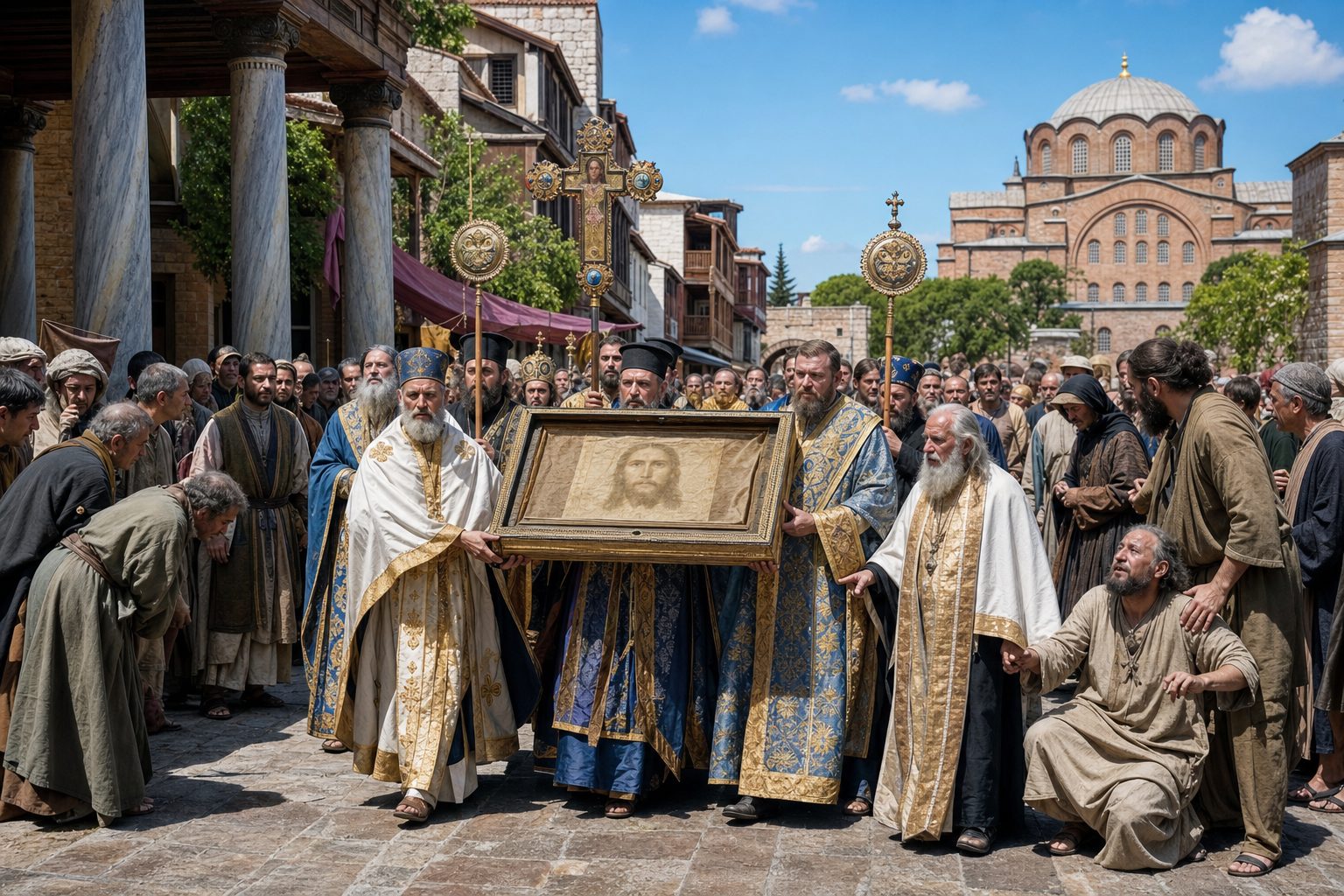
In the days of the appearance of our Lord Jesus Christ on earth, when he was living among men and preaching about the Kingdom of God, he passed through the cities and weights of Judea and the surrounding lands, "healing every sort of disease and every sort of infirmity in the people", in Edessa, a Syrian city on the other side of the river Euphrates, there lived Prince Agar.
He suffered from an incurable disease, <unk> leprosy: on the outside he was covered with bluish sores; on the inside he felt his bones broken and his whole body relaxed.
340 B.C.); according to his own words, he included this story in his history, based not only on the legends, but also on the written documents he found in the Edessa archives.
The 5th-century Armenian historian Moses of Khoren describes an incident in which Avgar heard about Jesus Christ, namely: Avgar learned about Christ from his ambassadors, whom he sent to the Roman tribune, ruler of Phoenicia, Palestine, Syria and Mesopotamia, <unk> the ambassadors on the way back were in Jerusalem
And here we saw the Savior's miracles.
The writer of the X century, Constantine Porfirorodny (d.
959), in which we find the most detailed account of the origin of the Uncreated Image, relates that Aggar tells of Christ by his servant Ananias, who returned from his journey to Egypt.] about the Lord Jesus Christ and the great miracles that were done by Him, <unk> healing the leper by His word,
And so, in the midst of all the sickness, and all the sickness, and all the sickness, and all the sickness, and all the sickness, and all the sickness, and all the sickness, and all the sickness, and all the sickness, and all the sickness, and all the sickness, and all the sickness, and all the sickness, and all the sickness, and all the sickness, and all the sickness, and all the sickness, and all the sickness, and all the sickness, and all the sickness, and all the sickness, and all the sickness, and all the sickness, and all the sickness, and all the sickness, and all the sickness, and all the sickness, and all the sickness, and all the sickness, and all the sickness, and all the sickness, and all the sickness, and all the sickness, and all the sickness, and all the sickness, and all the sickness, and all the sickness, and all the sickness, and all the sickness, and all the sickness, and all the sickness, and all the sickness, and all the sickness, and all the sickness, and all the sickness, and all the sickness, and all the sickness, and all the sickness, and all the sickness, and all the sickness, the sickness, the sickness, the sickness, the sickness, the sickness, the sickness, the sickness, the sickness, the sickness, the sickness, the sickness, the sickness, the sickness, the sickness, the sickness, the sickness, the sickness, the sickness, the sickness, the sickness, the sickness, the sickness, the sickness, the sickness, the sickness, the sickness, the sickness, the sickness, the sickness, the sickness, the sickness, the sickness, the sickness, the sickness, the sickness, the sickness, the sickness, the sickness, the sickness, the sickness, the sickness, the sickness, the sickness, the sickness, the sickness, the sickness, the sickness, the sickness, the sickness, the sickness, the sickness, the sickness, the sickness, the sickness, the sickness, the sickness, the sickness, the sickness, the sickness, the sickness, the sickness, the sickness, the sickness, the sickness, the sickness, the sickness, the sickness, the sickness, the sickness, the sickness, the sickness, the sickness, the sickness, the sickness, the sickness, the sickness, the sickness, the sickness, the sickness, the sickness, the sickness, the sickness, the sickness, the sickness, the sickness, the sickness, the sickness, the sickness, the sickness, the sickness, the sickness, the sickness, the sickness, the sickness, the sickness, the sickness, the sickness, the sickness, the sickness, the sickness, the sickness, the sickness, the sickness, the sickness, the sickness, the sickness, the sickness, the sickness, the sickness, the sickness, the sickness, the sickness, the sickness, the sickness, the sickness,
And as the prince could not go to Judea by himself, he sent a request to the Lord Jesus, begging him to come to him in Hades.
And not knowing whether his request would be granted, he sent Ananias, a skilled painter, to Palestine, and charged him to paint the face of the Lord upon the image. And the prince desired to have the joy of seeing the face of Jesus Christ in his sickness, for so great was his love of Christ.
It's a belief based on hearsay.
Hagar's message to the Lord Jesus was as follows: "Prince Hagar of Hades to Jesus, good Savior who has appeared in the regions of Jerusalem, rejoice in the flesh.
I've heard of you and your glorious miracles, how without medicine and medicine you heal diseases, make the blind see, the lame walk, cast out evil spirits, cleanse the lepers, the paralyzed, the bedridden for many years, heal with the word and resurrect.
The dead: I have heard of you that you do such miraculous signs, I have come to such two conclusions about you, are you either God or the Son of God who came down from heaven.
Wherefore I beseech thee, that thou wouldest please to come and heal me of this incurable disease, whereof I have been afflicted for many years; and also that thou art despised, and that the Jews plot to do thee harm.
Behold, I have a small city, but it is a city of beauty, and there is much in it: come, I pray thee, to me, and abide in my city, for there is food for us both. And Hananiah the scribe came to Jerusalem.
He saw the Lord Jesus teaching in the plain, but could not get near him because of the crowd.
While waiting for the people to disperse, Ananias stepped on a rock, slightly raised above the ground; from there he gazed intently at the face of the Savior, intending to portray him; and Ananias could not do so, for the All-Seeing One, displeased with the painter's intention, changed his face.
Divine, unfathomable, beyond the reach of human hands, to glory and grace.
Ananias had been working for a long time, but nothing had come of it, until the Lord told the Apostle Thomas to go and bring a man, standing on the rock, to make his face.
And when he was brought in, and was not yet able to speak, the Lord called him by name, and gave him the name of Ananias the painter, and told him the reason of his coming, saying, Where is the letter of your lord Hagar, which thou broughtest to me from Hades?
And Ananias being astonished and afraid because of the vision which he had seen, took the letter and delivered it to the king.
"Blessed are you who have not seen and yet have believed. For it is written about me, 'Those who have seen me will not believe, and those who have not seen will believe and have eternal life.'
You write to me, saying, 'I am going to you, but I must finish my work, and when I have finished, I go to the Father who sent me.'
And when I am taken up to him, I will send one of my disciples to you, and he will heal you and give eternal life to those who are with you".
When the Lord Jesus Christ wrote this letter to Agar, he sealed it with a seal that had the Hebrew inscription: "A divine vision, a divine miracle".
Then the Lord, fulfilling the desire of Agar and the painter, commanded that water be brought, and after washing His holy face, He wiped it with the four-pointed cloth given to Him.
And when the Lord had given this image to Ananias, and the letter, the Lord said, Take it, and give it to him that sent thee.
(John 20:30) According to the Gospels, the news about Jesus Christ spread as far as Syria, and from there people brought the sick to him. (Matthew 4:24) (2) The writers of the first three centuries before Eusebius are silent.
But this proof is as negative as the first, because Cicero's Republic was only discovered in 1822, which is surprising because the Greeks of the East didn't know about it.
It is said that Julius the African spoke of Avgar, the king's holy husband, in Edessa, also to Moses of Chora (5th century, book 2, ch.
4) Blessed Augustine says that Jesus Christ wrote nothing.
He says this in dispute with the Manichaeans, who relied on writings purportedly written by Christ Himself about Himself, and he generally understands that Jesus Christ did not set forth and did not intend to set forth in writing teachings about Himself, and this cannot apply to the brief letter of Jesus Christ to Agar.
Jesus Christ stooped to write on the ground before the Pharisees, who brought a woman who was a prostitute to Him. (5) In the letter of Jesus Christ, there is a reference to John (XX, 29).
6) Eusebius's year of death of Jesus Christ, 340, falls on the 30th year of His life (on the 15th of Tiberius).
7) Pope Gelasius decreed that this work was apocryphal; this meant that it was not included in the canonical writings; however, not all apocryphal writings are credible.
<unk> In the Slavic minia, it is said that Ap. Fadday rested in Virita, a city of the Phoenicians.
And he returned [Tradition, recorded by Constantine Porphyrod, reports that when Ananias, returning to his homeland, reached the city of Hierapolis, he, stopping outside the city, hid the image of the Face of Christ in a pile of newly made bricks.
At about midnight, the people of the city saw a fire surrounding the place and found a hidden temple there, along with an image of the Savior on one of the bricks.
[Ananias went to Edessa to see his prince and gave him the unhandmade image of the face of Christ and the letter.
And when he had received them, he was filled with joy, and gave thanks with love, and bowed himself before the image of Christ, and was immediately healed of his sickness, so that only a small part of the leprosy remained on his face until the time came for the disciple sent by the Lord to come to him.
After the Lord's own suffering, resurrection, and ascension to heaven, St. Thaddeus, one of the seventy apostles, came to Edessa by the grace of God.
And the rest of the leprosy departed from him, and he came out of the tub clean in body and soul.
He and all his family were baptized and the name of the only true God, the Lord Jesus Christ, was proclaimed in Ephesus. An ancient idol of a pagan god was standing at Ephesus' gates, and it was commanded that anyone entering the city should worship it.
And he overturned it, and destroyed it; and he made a round hole in the stone wall above the gate, that the rain should not fall thereon: and he laid the frame of the image of Christ, which was not made with hands, upon a plank of incorruptible wood, and overlaid it with gold, and adorned it with precious stones, and set up a statue of him in the temple of the LORD.
And he wrote on the wall above the gates, and on the wall above the gates, with these letters of gold:
O Christ, O God, none that trust in thee shall be ashamed.
And he commanded all that entered into the city, and all that went out of the city, to worship the divine image of Christ; and he made a law, that the image of the Lord should be honored. And this law of the law was observed for many years, as in the days of his life, and as in the days of his father.
his son, who was his prince in Edessa, and his grandson.
Then, when one of Agar's great-grandchildren became a prince in Edessa, ancient pagan wickedness was revived in the city.
Seeing at the city gates the image of the Savior, venerated by all who entered and went out, the prince, as an enemy of Christ, became indignant; he wanted to throw down the divine image from the wall, putting an idol in its place.
When the bishop of Edessa learned of this, he came at night with the clergy to the gates of the city and, climbing the stairs, placed a lamp with oil in front of the holy image of Christ.
And he smote the place, and leveled it, as God had commanded him.
When the unmade image of Christ became invisible, the wicked prince abandoned his plan.
And the memory of the holy image was long forgotten in the memory of men, and the place where it stood was forgotten; and no one knew of it until the day of its miraculous appearance after many years, which was done as follows.
In the days of the pious king Justinian, the Persian king Khosrau with a large army approached Edessa, surrounded it, and began a persistent and prolonged siege.
When the citizens, weary of perplexity and great fear, were praying to God with tears, one night a brilliant bride appeared to the bishop of Edessa, Eulavius, shining with great glory. Pointing at the city gate and the place in the wall, she said:
At the top of these gates is hidden a divine unmade image of Christ the Saviour. You'd do well to take him out of the enclosure.
The bishop hurried to the door, and when he had gone up to the place which was on the wall, he found it as it had been told him in the revelation; and when he had known the barrier, he dug it up, and took away the board; and he found the pure and holy image of Christ whole and unblemished, the lamp, notwithstanding that so many years had passed,
And on the very board, which had the image, there appeared another like likeness, not made with hands, of the Face of Christ.
The bishop took the coat of mail and showed it to them, and they were all overjoyed, and they took courage to believe in the Lord.
The bishop, making a fervent prayer, carried the image of the Savior on the walls of the city, showing the face of the Savior to the Persian soldiers who were besieging the city, and immediately the entire Persian army, driven by divine power, turned to flight.
So Edessa by the mercy of Christ our God and the manifestation of His unmade most holy image was delivered from her enemies.
Then, also after many years, when in Greece there was a king Romanus, also called Lycapenes, who shared power with Constantine, the son of Leo the Wise and his son-in-law, the holy shroud with the unhandmade image of the divine Face of Christ was brought from Edessa,
and the Saracens in Constantinople. Now all Syria, including Edessa, was under the power of the Saracens.
The transfer was carried out in this way: the Greek king Roman, wishing to have in the Castle an invaluable treasure (a non-manufactured image of the Saviour), many times sent to the Emir of Sarajevo a request to give him a non-manufactured image of Christ.
But the emperor, who was being urged by the Christians of Edessa, did not want to give the image, and war broke out: the Roman king sent his army to Edessa and encircled the city, which was desolated.
The Emperor of Saracen, under whose rule Edessa was, did not want to give away free; the Christian king, moved by a great desire to have a non-handmade image of Christ, gave the Emperor twelve thousand silver coins and brought back from the Greek captivity two hundred noble Saracens, to which he added his own royal
behind a golden seal, promising never to make war on Edessa or its surrounding cities.
Having obtained this wish, the king accepted the unmade image of Christ and with it the letter which, as noted above, our Lord Jesus Christ wrote to Avgar, Prince of Edessa; by the hands of the bishops and other honest men of spiritual rank the holy image was carried to the Cathedral.
Many miracles were performed on the way and in the palace itself by the honest image: all kinds of diseases were cured, the blind received sight, the deaf heard, the lame walked, and demons were cast out.
The man who had the demon cried out and was healed.
The celebration of the transfer of the non-manufactured image of Christ was established on the 16th day of August, when it was received with great honor and solemnity by the reigning city and placed in the church of the Most Holy Mother of God of Faros [This temple was built by Emperor Michael (856-867 years) ] to protect the hail and to glory.
To our God and Father and to the Holy Spirit be glory, now and forever and ever. Amen.
Amen [Constantine the Porphyrodite describes the transfer of the non-manufactured image from Edessa and the letter of Christ to Avgar to Constantinople in 944. The non-manufactured image was kept in Constantinople until 1204.
1118), it was transferred by Emperor Nicéphore Phocaeus (963-969) in 968.
<unk> According to one story, the statue was given by John the Paleologist to the Genoese general Leonardo de Montaldo in about 1362 for saving the Greek Empire from Saracen attack, and Montaldo gave it to the monastery of St. Bartholomew in Genoa, where it remains today.
According to another, more likely tale, he was kidnapped by the Venetian doge Dandorlo in 1204-1261 during the rule of the Crusaders in Constantinople, but the ship on which he was with other sacred objects sank in the Propontid.]
To your most holy image we worship, we pray for the forgiveness of our sins in Christ our God, for it pleased you to bear your flesh on the cross, to deliver us from the works of the enemy.
Your unspeakable and divine gaze on man, the unspeakable Word of the Father, and the unspeakable and unspeakable image of the victorious leader of your unfalsified incarnation, we venerate that with reverence.